



When to consider surgery
The timing of cataract surgery depends more on its effect on daily life than on the degree of clouding alone.
Glare from oncoming headlights, difficulty reading newspapers or price tags, trouble seeing stair edges, or visual acuity below 0.7 on Japan's decimal scale causing concern about driving license renewal: these are examples of when to consider surgery.
If reduced vision is not causing difficulty, monitoring with eye drops to slow progression is also an option. We discuss the timing with you so you can make an informed decision.

The procedure
Ultrasound breaks up and removes the cloudy natural lens, which is replaced with an intraocular lens. The procedure uses a small incision of about 2-3 mm at the edge of the cornea and usually does not require stitches.
Surgery takes about 10-20 minutes per eye. Anesthesia is given as eye drops and, when necessary, an injection around the eye. You remain awake. Pain is not usually felt, although light may seem bright and you may feel water flowing.
No hospital stay is needed; you return home the same day. Our surgery sessions are on Tuesday and Friday afternoons.
Your surgery pathway
Consultation
We assess the cataract and its effect on your daily life.
Preoperative tests (2-4 weeks before surgery)
Eye length measurement, corneal endothelial cell checks, OCT and blood tests help determine your lens power.
Scheduling and explanation
We provide written information on the procedure, the day itself, costs and possible complications. Family members may join you.
The day before and day of surgery
Begin the prescribed drops. Please attend with someone who can accompany you home.
Surgery
Allow about 2-3 hours from arrival to payment.
Follow-up
Visits are usually the next day, after 3 days, after 1 week and after 1 month. Wednesday follow-up after Tuesday surgery is by appointment, arranged beforehand. Continue drops for about 3 months.
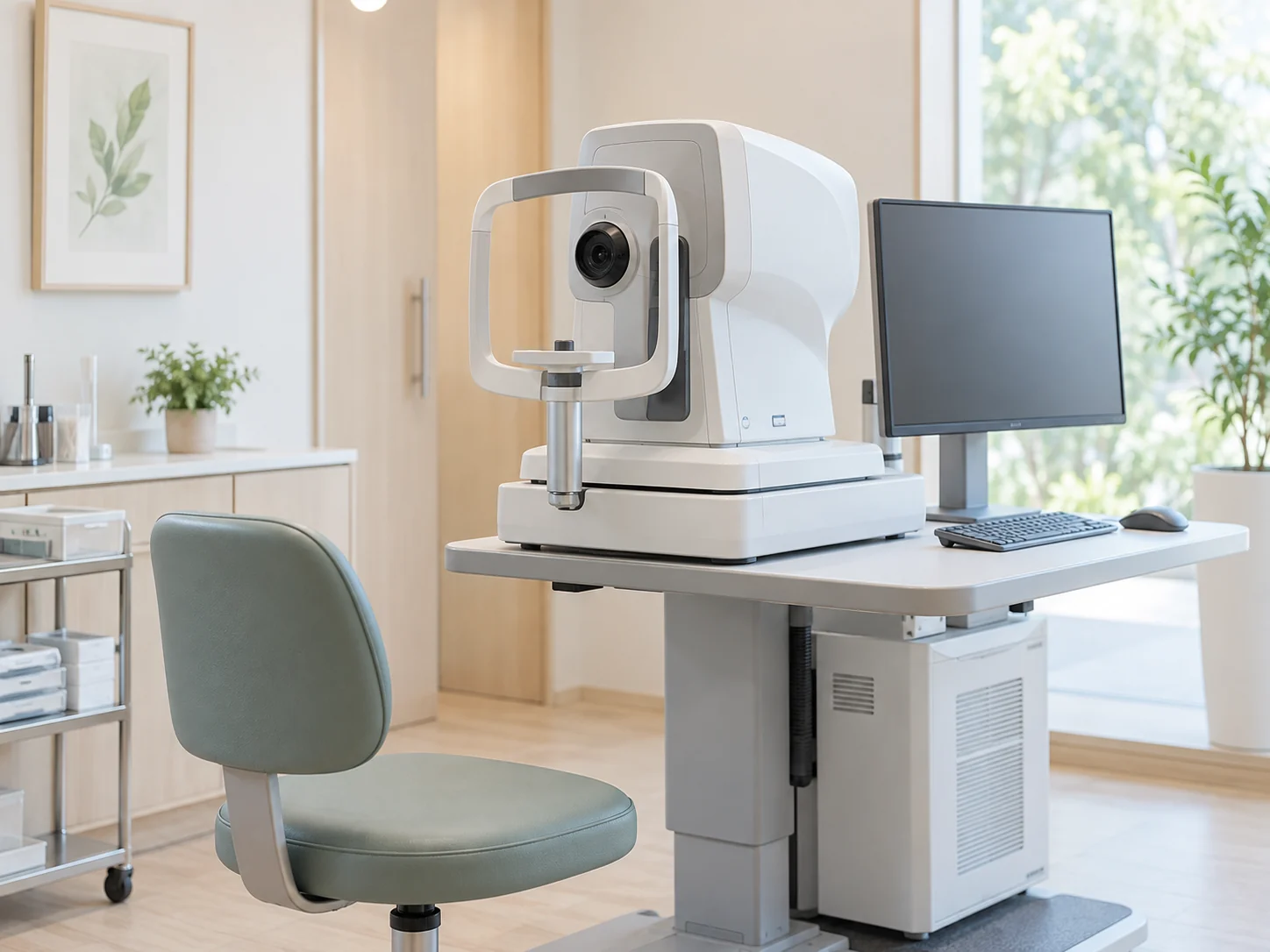
If both eyes require surgery, we operate on one eye at a time, 1-2 weeks apart.
Lens options
Monofocal lens (insured care)
This lens focuses at one chosen distance. Distance focus can make driving and outings easier, with reading glasses for close work. Near focus can help reading and crafts, with glasses for distance. It is covered by Japanese public health insurance, with the patient's applicable copayment.
Multifocal lens (additional fee)
This lens is designed to focus at more than one distance, such as near and far. It aims to reduce the situations in which you need glasses.
Multifocal lens surgery falls under Japan's sentei ryoyo system: surgery and follow-up are covered by public health insurance, while the extra lens cost and some additional tests are paid in full by the patient. The additional fee depends on the lens.
The suitable choice depends on your corneal astigmatism, retina and optic nerve, and what you look at most in everyday life. Multifocal lenses do not suit everyone and may not be recommended for some eye conditions.
Estimated costs
Monofocal surgery (per eye)
- 30% copayment
- about ¥45,000
- 20% copayment
- about ¥30,000
- 10% copayment
- about ¥15,000
These are estimated payments on the day of surgery under Japanese public health insurance. Preoperative tests, follow-up visits and eye drops cost extra. Costs vary with medication and surgical technique.
Multifocal surgery
Under sentei ryoyo, surgery and consultations are covered by public health insurance, but the extra lens cost and some additional tests are paid entirely by the patient. As the fee varies by lens, we provide a written estimate at the preoperative consultation. The self-pay portion is excluded from Japan's high-cost medical expense benefit.
High-cost medical expense benefit
Japan's public health insurance system can reimburse eligible monthly out-of-pocket costs above a set limit. Having both eyes operated on in the same month or in different months can affect your cost. Please check with your insurer. Reception can explain the application process.
Risks and complications
Cataract surgery is widely performed, but complications are possible for any patient.
During or after surgery: endophthalmitis (infection inside the eye), posterior capsule rupture, expulsive hemorrhage, corneal swelling, raised eye pressure, retinal detachment or macular swelling. These are uncommon but include complications that can leave lasting effects on vision.
Later complications: posterior capsule opacification, when the membrane behind the lens becomes cloudy. Vision may become blurred months or years later. This can be treated with a YAG laser at our clinic.
Multifocal lens effects: halos or glare around lights at night, reduced contrast, and time needed to adjust to your vision. Replacing a lens is not straightforward, even if you do not adapt to it.
Understanding your own risks
Before surgery, we explain the risks specific to your eyes. Please ask about anything you are unsure of.

Life after surgery
On the day: you go home wearing an eye patch. Avoid washing your face or hair. Use a protective patch when sleeping so you do not rub the eye.
The next day to 1 week: we remove the patch at your visit. You may watch television and read. Wash only below the neck; have your hair washed with your face tilted upward, for example at a salon.
1 week to 1 month: you may resume normal face and hair washing and light exercise. Avoid pools, hot springs and work in dusty places.
Driving: wait until your vision stabilizes and the doctor gives permission. This varies by person, but about 1 week is a guide.
Glasses: we recommend updating your prescription around 1-2 months after surgery, once your vision has stabilized.