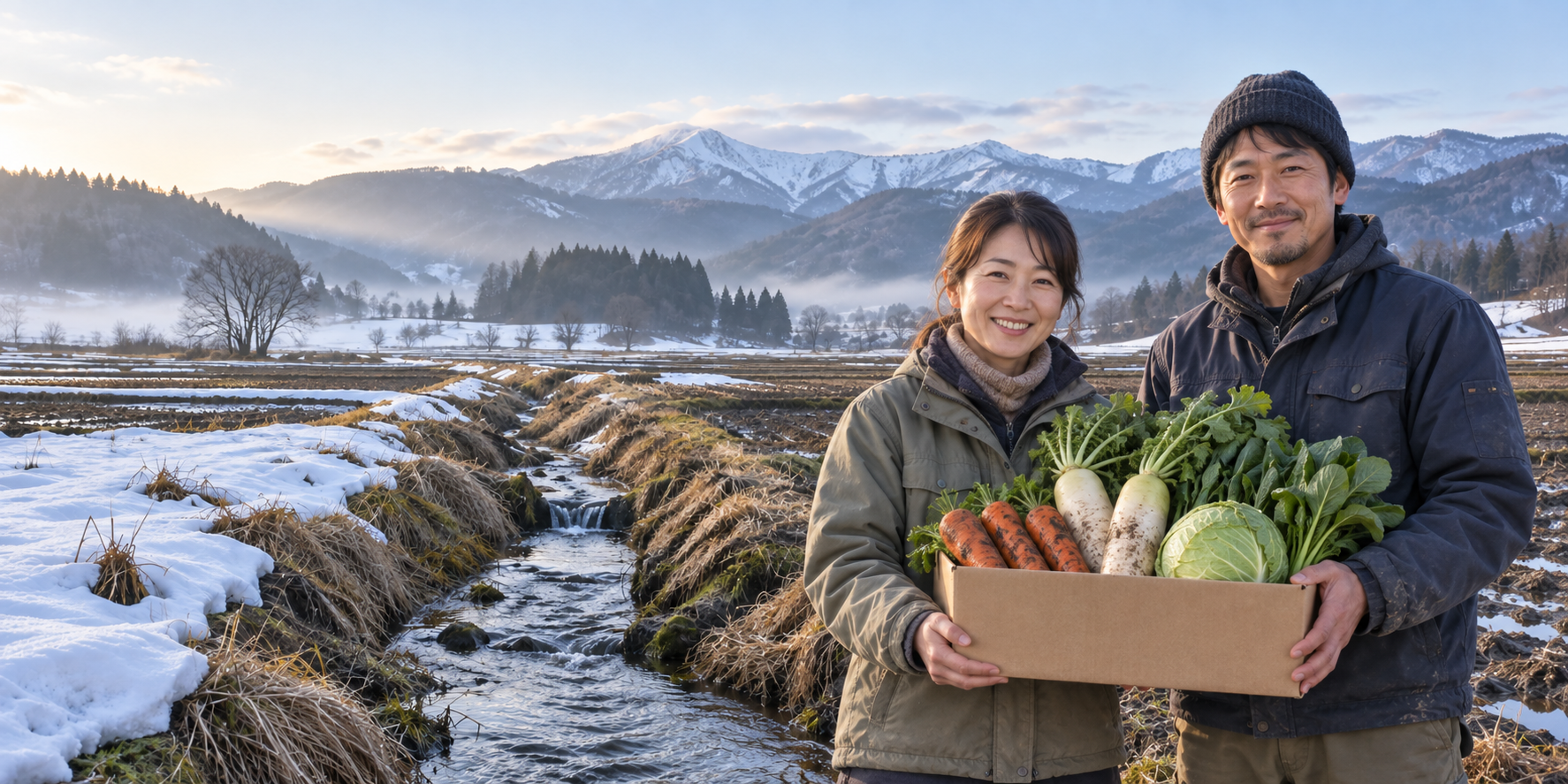
Yukishiro, Yamagata, Japan.
Where the snow melts,
our farming year begins.
In April, mountain snow melts and its water reaches our fields.
That is where our year begins.
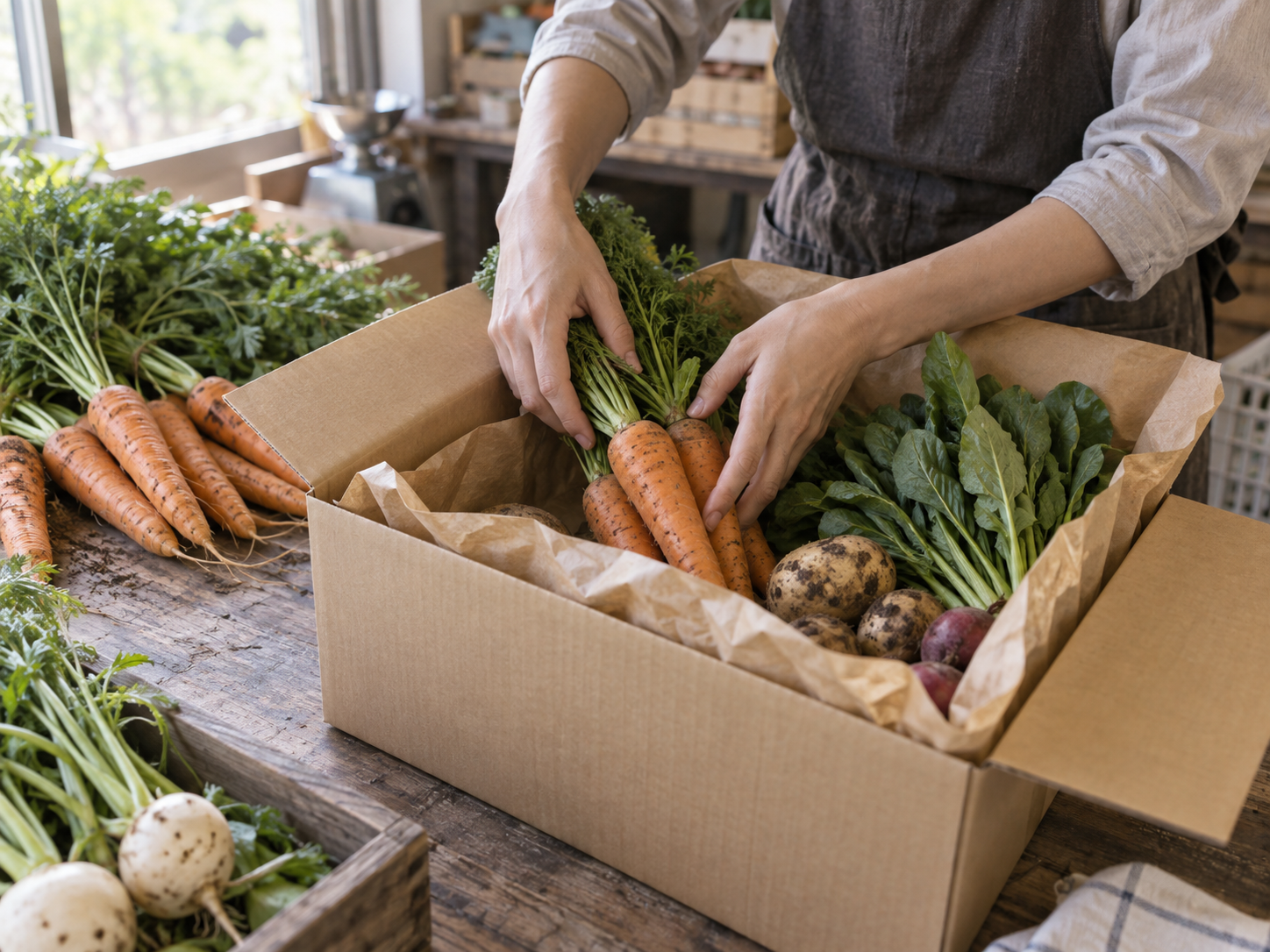
Picked in the morning, packed the same day.
Farm-direct means from our fields to your table, without a wholesale market.
¥1,000 off your first box. No minimum commitment. Change your next delivery before the stated deadline.
Three generations, farming since 1953
Rice and main vegetables: special cultivation (Japan's lower-input growing standard)
Dispatched on harvest day; usually next day to Honshu
Around 340 subscribing households
Good vegetables. But where has the season gone?
The same vegetables line the shelves all year, the same size and at the same price. It is convenient. Yet our meals tell us less about the time of year. The two weeks when cucumbers taste their best, or the deepest cold that sweetens daikon, can pass unnoticed.
Our boxes have no fixed contents. We pack the best of that week, so every delivery is different. It takes a little flexibility. In return, you can feel the season changing the moment you open the box.
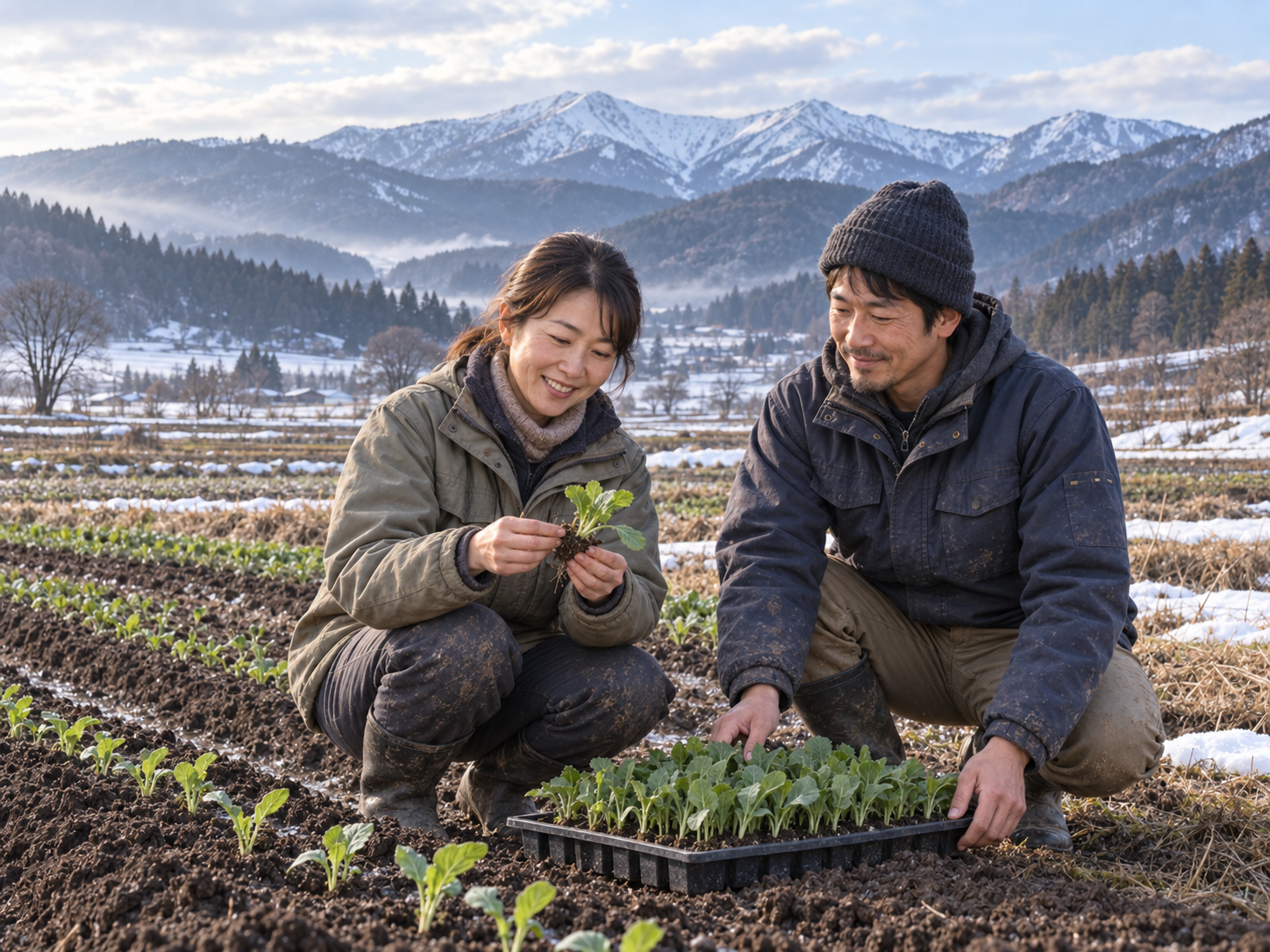
There is a reason for the sweetness.
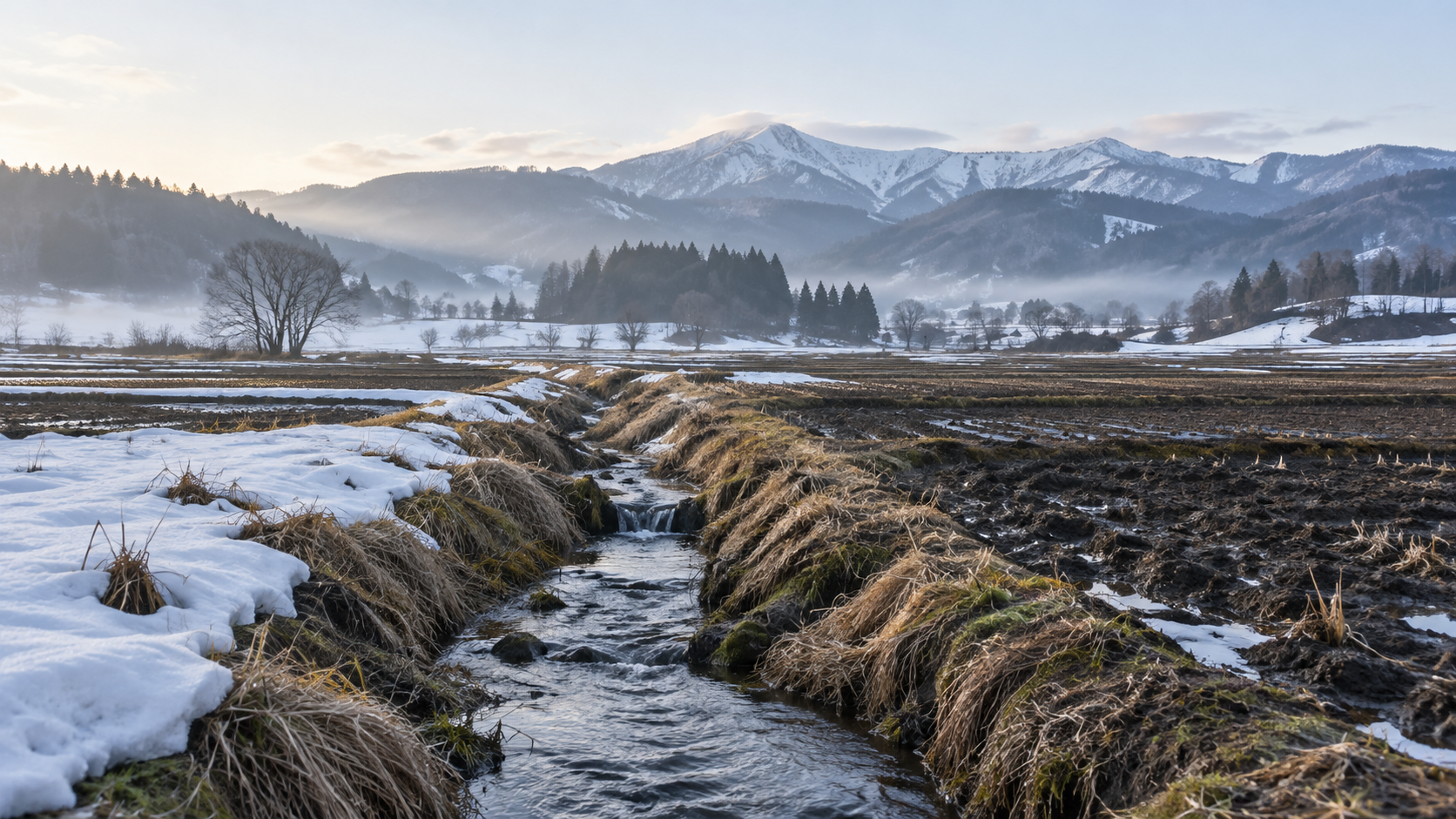
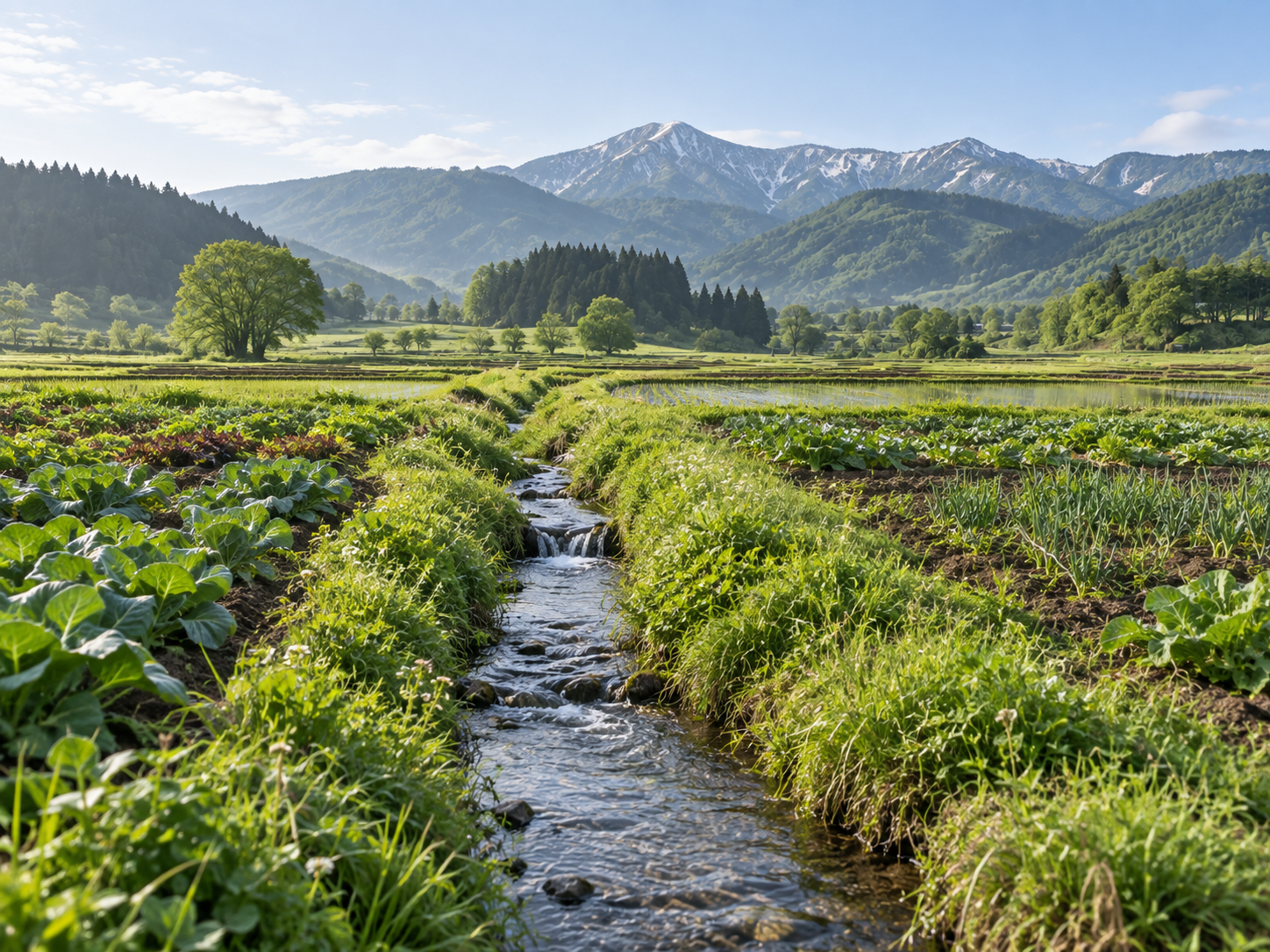
Snowmelt
Water for our fields and paddies comes from snow that gathers in the Ou Mountains through winter. It slowly filters through the ground, picking up minerals, and stays cool even in midsummer. In mid-April, when bands of snow still stripe the mountainside, we open the irrigation gates.
Warm days, cool nights
At 340 meters above sea level in this inland region, summer nights can fall to around 15°C. Plants make sugars through photosynthesis during the day, then use them in respiration at night. Cooler nights slow that consumption, leaving more sugar in the fruit and roots. That balance is why crops grown here taste sweet.
Snow as a storehouse
Winter snow can lie more than two meters deep. Once it shut the region away; now we use it to store vegetables. Beneath the snow, temperatures stay close to 0°C, and vegetables accumulate sugars to resist freezing. That is why the carrots we bring out in March are sweeter than they were in autumn.
Three things we stand by.
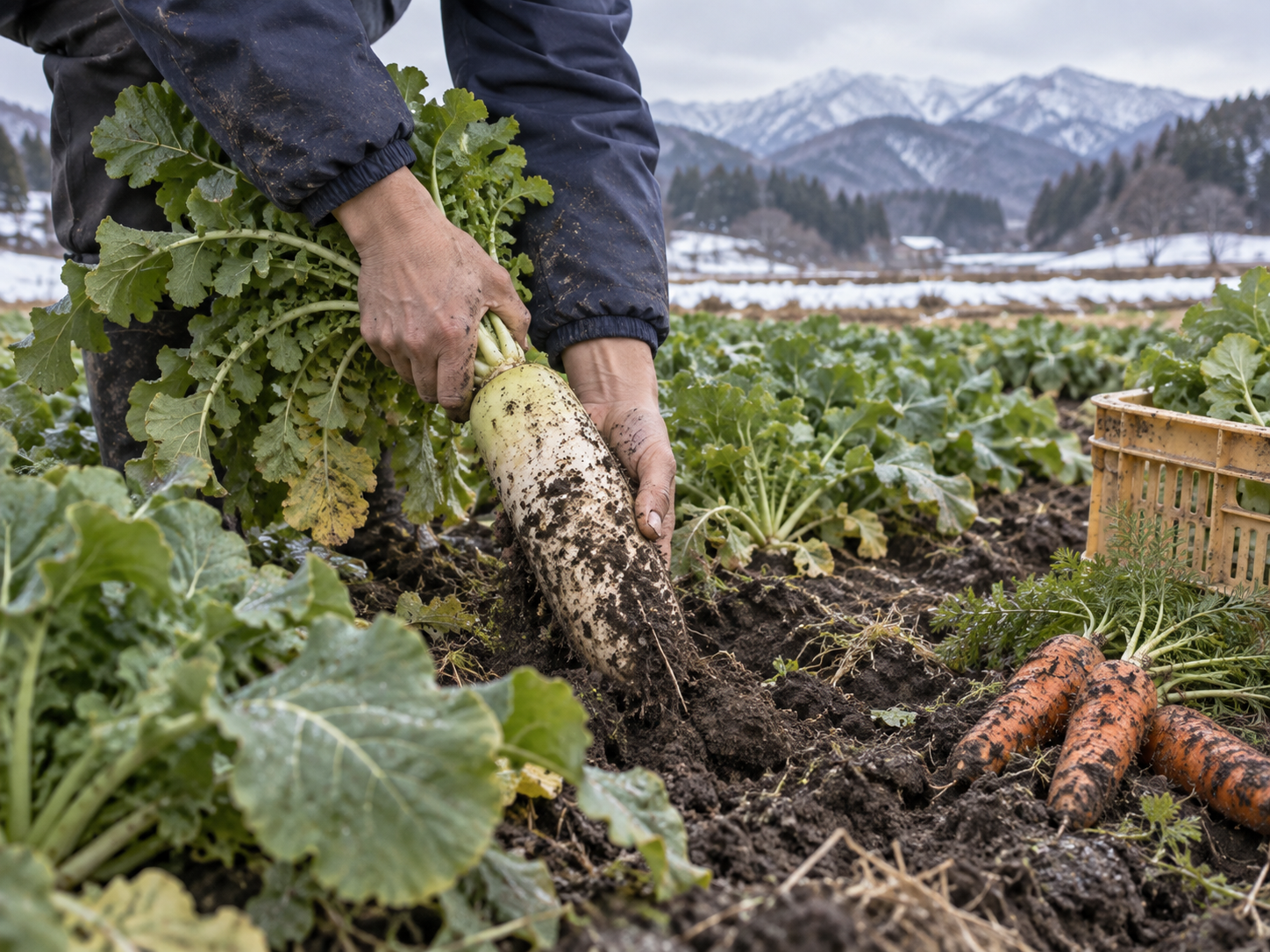
1. Ship on harvest day
Our sorting benches and cold storage are a three-minute walk from the fields. Harvesting starts at five in the morning; by afternoon the vegetables are chilled and packed for the evening collection. Delivery usually takes one day to Honshu and two to Hokkaido, Kyushu and Shikoku. Okinawa and some outlying islands take longer. We shorten the journey from field to table as much as we can.
2. Meet Japan's special cultivation standard
For our rice and main vegetables, both the number of applications of designated pesticides and nitrogen from chemical fertilizers are no more than half the local conventional levels. We keep application records for every plot and have them checked. Shino Otsuki is the cultivation manager; the Yukishiro Agricultural Produce Verification Council is the verification body. We use the specified quantitative description, rather than claims that the labeling rules do not permit.
3. Give the soil time
We do not skip the time needed for compost and green manure to restore the soil, even when yields fall. Resting a field reduces that year's income, but we will not pass on depleted soil built up over three generations. We test every plot once a year and replenish only what it needs.
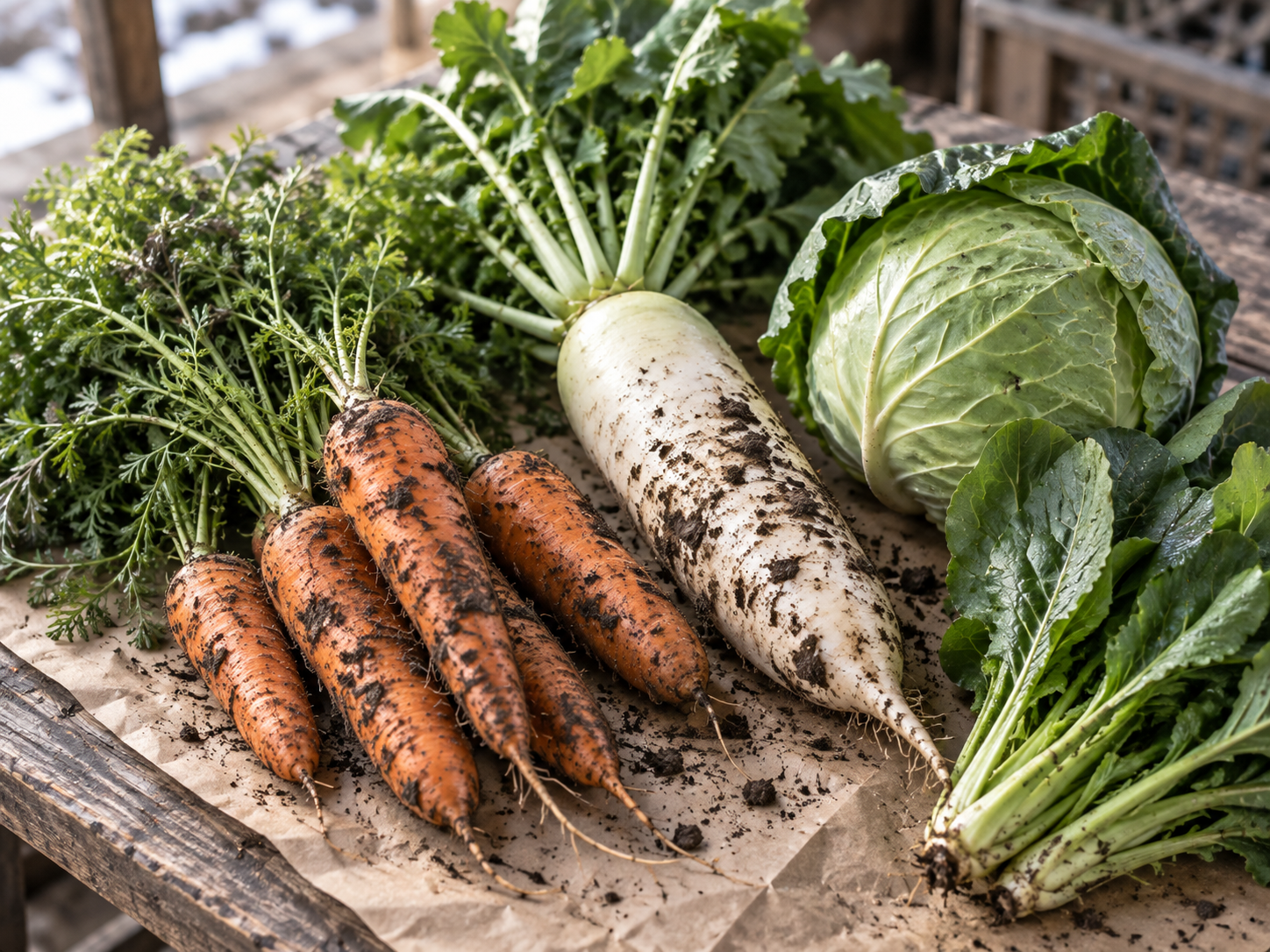
Everything our fields
have to give.
The best of each season,
from field to table. Vegetables, rice, fruit and preserves.
What we grow, delivered as it is.
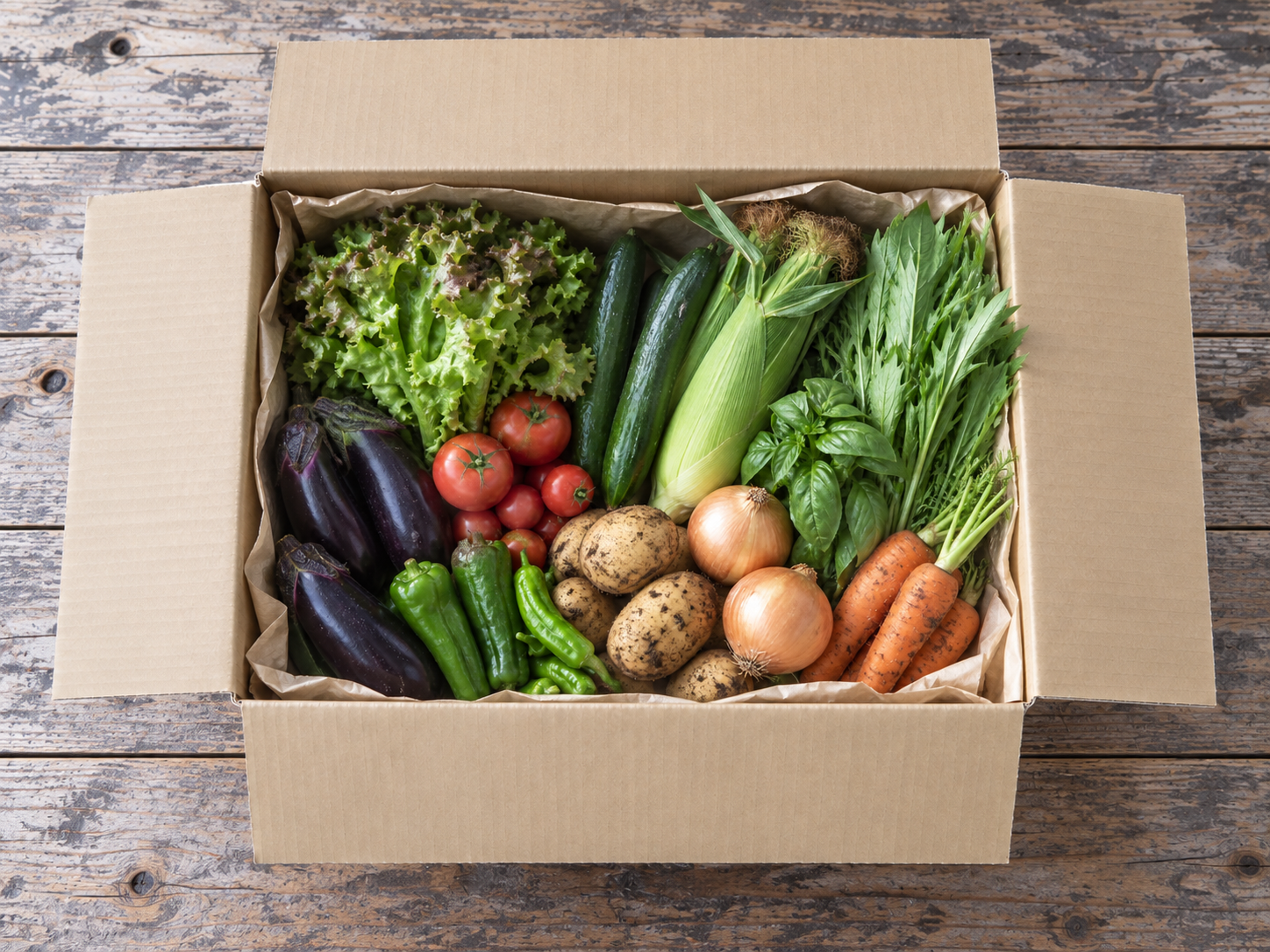
Tax incl.; shipping extra
Vegetable box S
7-8 varieties / approx. 2.5 kg
¥2,480Vegetable box M
10-11 varieties / approx. 4 kg
¥3,280Vegetable box L
13-14 varieties / approx. 6 kg
¥4,280We choose what is ready in the fields, so we cannot promise particular varieties in advance. Every box includes a letter with the contents and storage advice.
Yukishiro specially cultivated rice
Yukishiro specially cultivated rice, 5 kg (milled to order)¥4,480Yukishiro specially cultivated rice, 2 kg (trial size)¥2,180We mill the rice after you order. Brown rice is available at no extra charge. Please order an amount you can finish within about a month of milling.
Seasonal vegetables and fruit
Snow-cellar carrots, 3 kg¥1,980Early March to late April
Cherries, 500 g gift box¥4,800Mid to late June / advance orders
La France pears, 3 kg (10-12 pears)¥3,880Late October to late November
Available only in season.
Preserves
Carrot and apple jam, 140 g¥780Dried vegetables, three-variety set¥1,280Aged mustard-green pickles, 2 × 200 g¥980Made from fruit and vegetables that miss our grading standards. Our kitchen lets us use this produce, about a fifth of the harvest, instead of throwing it away.
Yukishiro Box subscription
The fields, delivered every two weeks.
The best vegetables in season, at a rhythm that suits your table. Enjoy the seasons without having to remember to order.
We currently deliver to around 340 households.
M plan, every two weeks
Around 10 varieties / approx. 4 kg
First box ¥2,580
Then ¥3,580 per delivery
Tax incl.; shipping extra each time
Know what is coming
We email the planned contents three days before delivery. If there is something you dislike or still have in the fridge, you can ask for a substitution then, before the box arrives.
Pause or leave whenever you need
There is no minimum number of deliveries. Request a pause, date change or cancellation in the subscription section of Checkout. Changes apply to the next delivery if received before the preparation deadline shown in that section and in each notification. Requests after the deadline apply from the following cycle. We will not call to persuade you to stay.
The third generation found a new way to sell.
Where it began
In 1953, my grandfather Genzo settled on newly opened land in Yukishiro. He started by making rice paddies and growing enough vegetables for the family. In 1978, my father moved into open-field vegetables harvested in summer and autumn, adding crops suited to the difference between our daytime and nighttime temperatures.
Why I came back
I began farming in 2016, after working for a company in Sendai. My father told me on the phone that the daikon had turned out especially well that year. I realized that none of us knew the faces of the people who ate it. Even in our best years, we did not know who our produce reached. To close that distance, we moved from local farm shops and roadside markets to selling through our own website.
Building the kitchen
We built our processing kitchen in 2019. Every year, about a fifth of the vegetables fail the grading: bent, forked or blemished, though their taste is unchanged. I hated seeing them left out of the boxes. We installed equipment for jam, dried vegetables and pickles. Some customers now order specifically for our preserves.
The farm today
Four family members and a few seasonal helpers tend seven hectares of vegetable fields and two hectares of rice paddies. We grow around 60 varieties a year. Not everything turns out well every year. When a crop struggles, we write about that honestly in the letter we send.
From those who keep a box on the way.
Tokyo / 40s / household of two
At first I worried about not knowing what would be inside. Now that is what I look forward to. I plan meals after the delivery arrives and find myself looking up recipes much more often. The letter helps me understand the condition of each vegetable, too.
Kanagawa / 50s / family of four
The snow-cellar carrots in March surprised us. My children choose to eat them raw because they are so sweet. I thought we would have too much, but the letter explained how to dry vegetables, so I tried it.
Osaka / 30s / living alone
When I asked to skip a delivery, what stayed with me was that nobody tried to talk me out of it. I resumed the next month. The rice really does taste good after cooling, so I buy an extra 2 kg for packed lunches.
These are excerpts from messages sent by current subscribers, shared with their permission.
Delivery costs and thoughtful gifts.
Dispatch and arrival
We dispatch by the second business day after your order. Produce leaves on harvest day, usually arriving the next day in Honshu and two days later in Hokkaido, Kyushu and Shikoku. For Okinawa and some outlying islands, where delivery takes longer, we replace delicate leafy vegetables with more robust items.
Shipping
| Honshu (Japan's main island) | ¥900 |
|---|---|
| Hokkaido, Kyushu and Shikoku | ¥1,300 |
| Okinawa | ¥1,900 |
Refrigerated delivery adds ¥330. Standard shipping to Honshu is free for orders of ¥11,000 or more, excluding the refrigeration charge. Subscription shipping is charged for each delivery.
Gifts
Noshi (traditional Japanese paper gift bands) and message cards are free. Specify wording for a summer or year-end gift, a celebration or a thank-you gift. Cherries come in a gift box as standard. A gift box for La France pears costs an additional ¥400. Vegetable boxes can take a noshi band only.
If you are away
Refrigerated parcels can only be held for a limited time before redelivery. If you know you will be away, specify your preferred date when ordering. Subscribers can request a date change from the notification email sent three days before delivery.
Frequently asked questions
Can I choose the vegetables?
No. We pack what is in the best condition that week, so we cannot promise particular varieties in advance. Subscribers can request substitutions through the notification email sent three days before delivery. For a one-off order, list anything you would like left out in the notes field. We will help where possible.
Are crops grown without any pesticides?
No. Our rice and main vegetables meet Japan's special cultivation standard: applications of designated pesticides and nitrogen from chemical fertilizer are each no more than half the local conventional levels. We use that quantitative description and avoid claims that the labeling rules do not permit. We keep application records for each field and can show them on request.
Will the vegetables arrive with soil on?
We leave some soil on root vegetables because washing shortens their storage life. Leafy vegetables receive a rough rinse in cold water before packing. Wash only what you are about to use.
Will there be too much?
The S box is intended for one or two people; M is for two to four. If you are unsure, start with S or try your first subscription box with ¥1,000 off. The enclosed letter tells you which vegetables to use first.
What if something arrives spoiled?
Contact us with photographs. Once we have checked, you can choose a refund or a replacement with your next delivery. Minor scuffing during transit is sometimes unavoidable, but we will always help if anything arrives unfit to eat.
This week's harvest comes only once.
Next week, something different will be ready. We can never make exactly the same box twice. Start with one box and see where it takes you. If it does not suit you, there is no need to continue.
Delivery times are estimates. Vegetable boxes can take a noshi paper gift band only.