Landing Pages / estate clearance / lifetime decluttering
OMOIRO
Start with what to keep.
Take time to decide.
An estate-clearance page built around a household inventory.
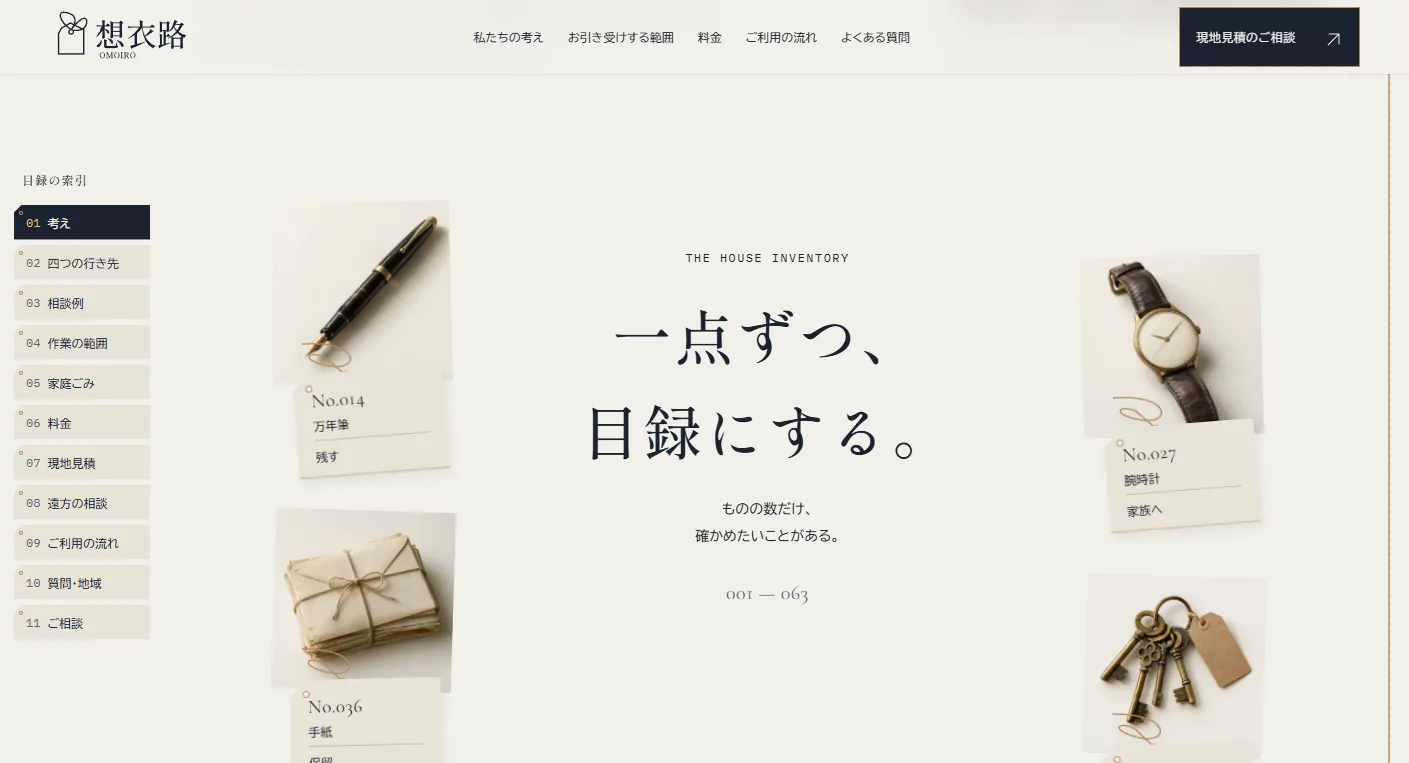
A single-page landing page for a business in Kawagoe, Saitama, offering estate clearance and helping people sort their own belongings in advance. Museum catalogues and item tags express a process of listing each possession and deciding with the family whether to keep it, send it to relatives, defer the decision or dispose of it. Diagrams and tables explain prices, additional costs, household-waste arrangements and rescheduling fees before leading to an on-site estimate consultation form. Seventeen photographic images were newly created with image generation.
View the live project (Japanese)This work is an original adaptation of a commissioned project.
A clear order for decisions,
with time to consider.
The audience is family members in their 40s–70s who live far away and have been asked to clear the family home. The page first explains how to decide what to keep and set uncertain items aside, rather than promising immediate clearance.
Prices are estimates for the company's sorting, preparation for removal and light cleaning. Disposal and collection, appliance recycling, delivery of keepsakes and specialist cleaning are listed separately. A diagram shows the client contracting directly with a locally licensed household-waste provider, avoiding the impression that the clearance business transports or disposes of the waste itself.
Afternoon light
and a thread through the page.
Ink indigo and porcelain white alternate, accented by kraft-paper tags and amber afternoon light. Headings use Shippori Mincho, catalogue numbers use Cormorant Garamond, and labels use IBM Plex Mono. The serif font is served as a subset containing only the characters used on the page.
The opening shows a Japanese-style room with dust drifting in shafts of light and a tag swaying from a string. Eight belongings float across three depth layers. A single string winds down between sections, hanging a tag at each chapter opening. The final scene brings light into a cleared room, where the string ends in a knot.
Sort each item's destination
as you scroll.
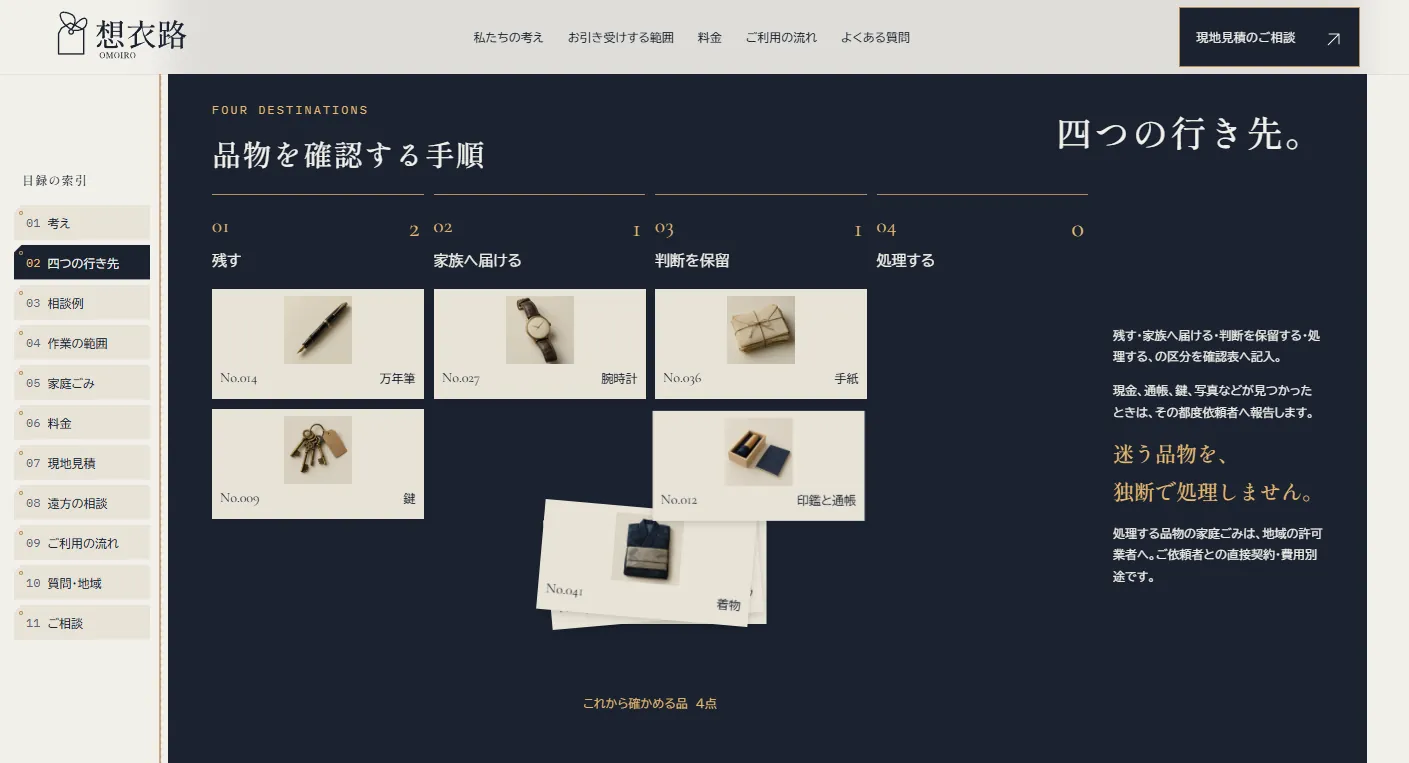
In the Four destinations scene, eight unchecked items move one by one into columns for keeping, sending to family, deciding later or disposal, with counts increasing as they arrive. Tags entering boxes illustrate the scope of work; line diagrams, floor plans with prices and annotated estimates make the conditions readable visually.
On desktop, a catalogue index on the left marks the current chapter and links to each section. The consultation form asks for location, floor plan, whether someone can attend, preferred date and interior photographs, then offers review, correction and completion. Sundays cannot be selected because the business is closed. The form is a demo; nothing is sent or stored.
Release pinned sections
for vertical reading.
On mobile, pinned sections become normal scrolling. Belongings form two staggered columns, and consultation examples use horizontal swipes. An estimate-consultation bar appears after the hero and hides in the final consultation section and footer. The layout stays within a 320 px screen. Reduced-motion settings stop the effects for a static reading experience.
Project details
- Version
- 1.0.0
- Project type
- Fictional website
- Scope of work
- Structure, copywriting, design & development
- Technologies
- HTML / CSS / JavaScript
GSAP / ScrollTrigger - Supported screen sizes
- Desktop, tablet & mobile